
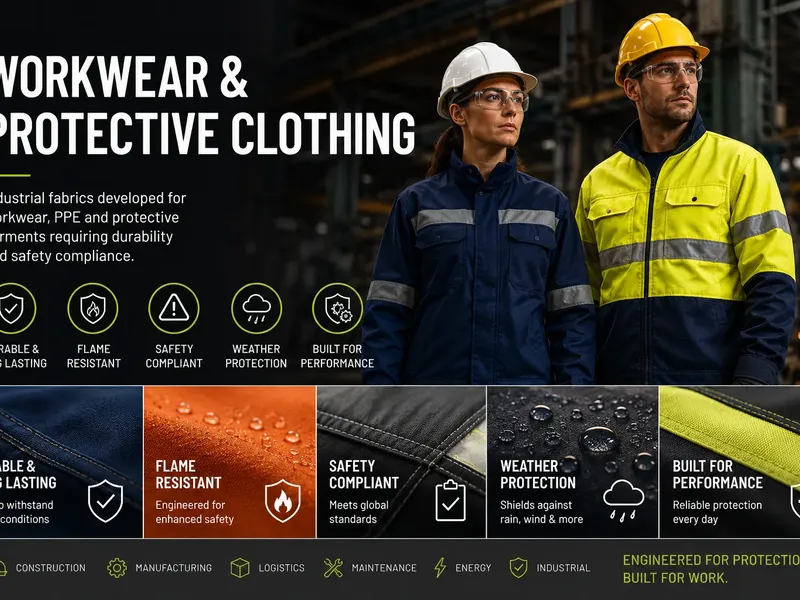
Workwear & Protective Clothing
Technical Description
Overview
Workwear and protective clothing encompasses garments engineered to shield industrial workers from thermal, electrical, mechanical, chemical, and environmental hazards while maintaining wearability across long shifts. Technical fabric is the foundation of this application because protection cannot be added as an afterthought—the fiber composition, weave, weight, and finish determine whether a garment meets recognized safety standards and survives repeated industrial laundering. For global wholesale buyers producing coveralls, jackets, and trousers at scale, fabric selection directly governs compliance, wearer safety, and total garment lifecycle cost.
Key Fabric Requirements
- Fabric weight: Industrial workwear typically ranges from 200 to 350 gsm. Lightweight FR shirting sits around 150–190 gsm, standard coverall fabric at 240–280 gsm, and heavy-duty welding or arc-rated fabric at 320–450 gsm for higher energy exposure.
- Flame retardancy: Fabrics should meet EN ISO 11612 (heat and flame protection) and EN ISO 11611 (welding) where applicable, with a limiting oxygen index (LOI) of 28% or higher. Inherent FR fabrics retain flame resistance for the garment's full service life rather than degrading after 50 or fewer wash cycles like some treated fabrics.
- Arc flash protection: For electrical hazards, target an Arc Thermal Performance Value (ATPV) of 8.0 cal/cm² for lighter garments up to 25+ cal/cm² for layered or heavyweight fabric, tested to IEC 61482 / NFPA 70E.
- Tensile strength: Warp and weft tensile strength of at least 800–1,000 N ensures the garment withstands abrasion, snagging, and mechanical stress on industrial sites, tested per ISO 13934-1.
- Tear resistance: Minimum tear strength of 25–40 N to prevent propagation of small tears into garment failures during active work.
- Water resistance and breathability: For outdoor and wet-environment workwear, a water column (hydrostatic head) of 5,000–10,000 mm combined with a moisture vapor transmission rate (MVTR) of 3,000–5,000 g/m²/24h balances weather protection with wearer comfort during exertion.
- UV protection: Outdoor workwear should provide a UPF rating of 40–50+, blocking over 97.5% of UV radiation for workers exposed to prolonged sun.
- Colorfastness and shrinkage: Colorfastness to washing and light of grade 4–5 (ISO 105) and dimensional shrinkage under 3% after industrial laundering, ensuring high-visibility colors and fit are maintained.
Recommended Fabrics
Inherent Flame Retardant Fabric is the preferred choice for permanent protection, as flame resistance is built into the fiber structure and does not wash out over the garment's lifespan—ideal for buyers requiring guaranteed long-term compliance across repeated laundering. This aligns directly with the broader Flame Retardant Fabric category, which covers both inherent and treated constructions suited to varying budget and performance requirements.
FR Workwear Fabric is designed specifically for everyday industrial coveralls, jackets, and trousers, balancing protection, weight, and comfort at the 240–320 gsm range that most general workwear programs demand. It is a versatile base for large-volume orders serving the Industrial Safety & Workwear Industry.
Arc Flash Protection Fabric is engineered for electrical utility, maintenance, and power sector workers, offering rated ATPV performance that protects against arc flash incident energy while remaining wearable for daily use. Oil & Gas Protective Fabric addresses the combined flash fire, static, and chemical splash risks of upstream and downstream petroleum operations, typically incorporating anti-static properties and multi-hazard certification.
Welding Protective Fabric is built for high-heat, spatter, and molten metal exposure, using heavier constructions and specialized finishes to resist ignition and burn-through during welding and cutting. For sun-exposed and outdoor roles, UV Protection Fabric extends worker safety beyond the factory floor, delivering high UPF performance for construction, roadwork, and field crews within the Outdoor & Adventure Industry as well as industrial settings.
Applications & Use Cases
- Oil and gas field workwear: Coveralls and jackets for upstream drilling, refinery, and petrochemical workers exposed to flash fire, hydrocarbon splash, and static ignition risks, where multi-hazard Oil & Gas Protective Fabric is standard.
- Electrical utility and power sector uniforms: Arc-rated shirts, coveralls, and jackets for linemen, electricians, and substation technicians requiring documented ATPV ratings to satisfy NFPA 70E and IEC 61482.
- Welding and metal fabrication garments: Aprons, jackets, and trousers for welders and foundry workers facing sparks, spatter, and radiant heat, demanding heavyweight fabric of 320–450 gsm with high thermal resistance.
- General industrial and manufacturing coveralls: Standard-duty workwear for maintenance, assembly, warehousing, and heavy-machinery operation, prioritizing durability, comfort, and consistent FR performance across large workforces.
- Outdoor construction and infrastructure crews: High-visibility and UV-protective garments for road, rail, and building site workers who combine sun exposure with mechanical and thermal hazards, benefiting from UPF 40–50+ fabric.
- Chemical processing and cleanroom-adjacent workwear: Garments requiring chemical splash resistance, anti-static finishes, and controlled particle shedding for plant operators handling reactive or hazardous substances.
Customization & Wholesale
FuncFabric supplies technical fabric for workwear and protective clothing on a wholesale and bulk basis, with a standard minimum order quantity (MOQ) of 1,000 to 3,000 meters per specification, and lower trial or sampling quantities available for new programs and lab dips. Fabric can be produced in standard widths of 150 cm and 160 cm, with custom width configurations available to reduce cutting waste for specific garment patterns.
Customization covers fiber blend and weight tuning within the 150–450 gsm range, custom dyeing to Pantone or buyer-specified color standards, high-visibility fluorescent shades, and durable printing including logos and reflective applications. OEM and ODM services are available, allowing buyers to develop private-label fabric specifications, proprietary finishes, and certified constructions under their own brand, with full technical documentation and third-party test reports for compliance verification.
Standard production lead time is 25 to 40 days depending on order volume, dyeing complexity, and finishing requirements, with sampling typically completed within 7 to 15 days. FuncFabric supports global export with experience serving buyers across North America, Europe, the Middle East, Southeast Asia, and Australia, and can accommodate FOB, CIF, and other standard Incoterms alongside export documentation, certificates of origin, and relevant material compliance certificates.
For large-volume and recurring programs, blanket order arrangements and scheduled deliveries help buyers manage inventory and stabilize costs, while consistent batch-to-batch quality control ensures color, weight, and performance uniformity across repeat orders. Buyers are encouraged to share end-use requirements, target certifications, and garment specifications early so that fabric construction, weight, and finishing can be optimized for the intended hazard profile and regulatory market.
Related Products (5)
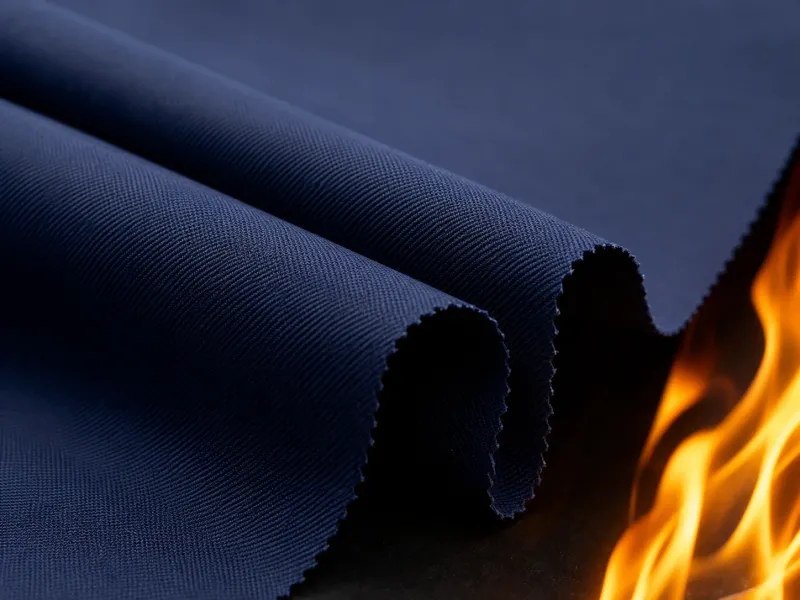
Inherent Flame Retardant Fabric
Permanent flame retardant fabric engineered with inherent FR fibers for industrial protective clothing.
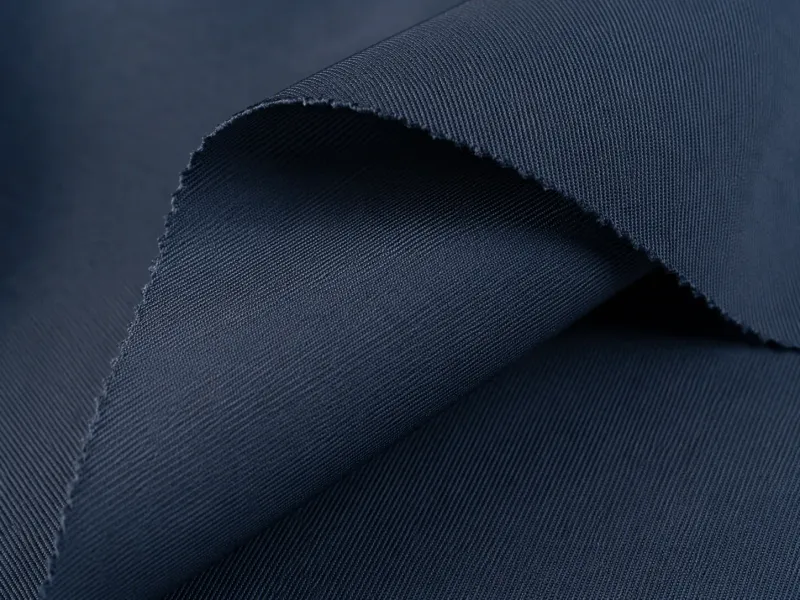
FR Workwear Fabric
Durable flame resistant fabric developed for industrial workwear and PPE applications.
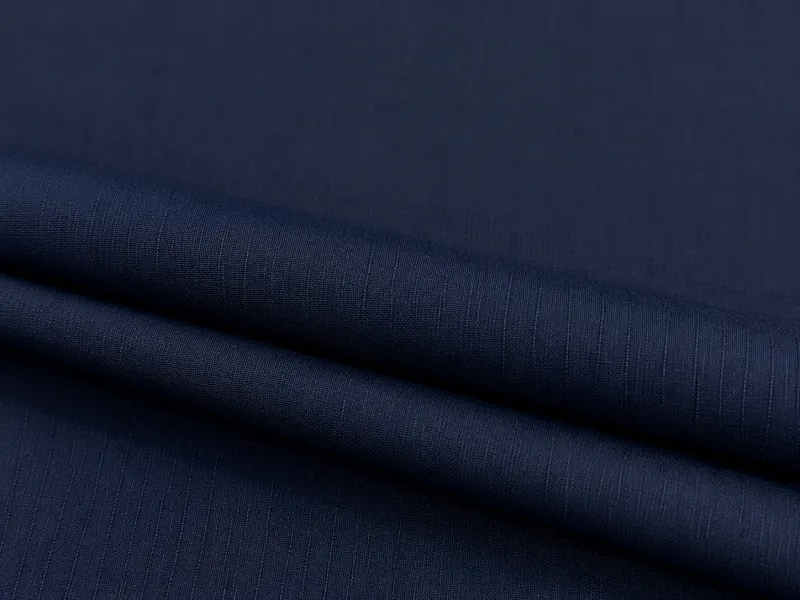
Arc Flash Protection Fabric
Advanced arc flash protective fabric for electrical safety clothing and utility uniforms.
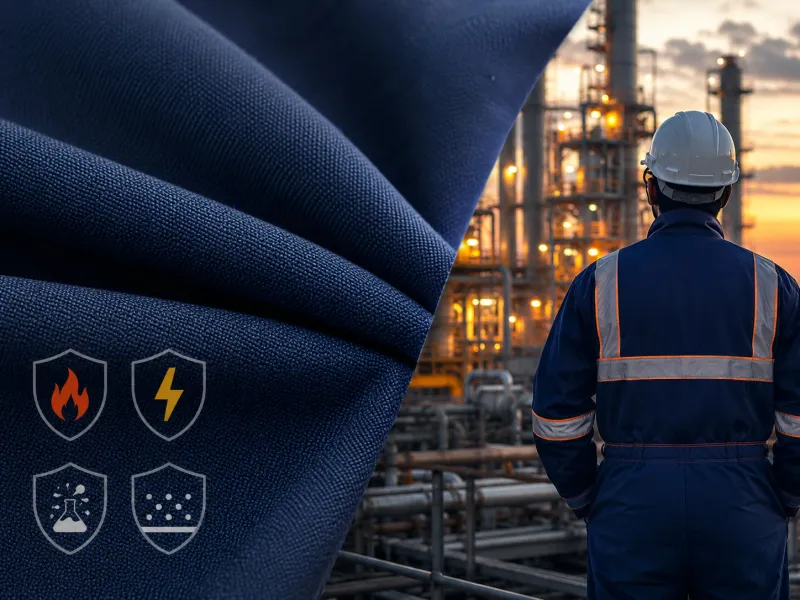
Oil & Gas Protective Fabric
Multi-hazard protective fabric developed for oil, gas and petrochemical industries.
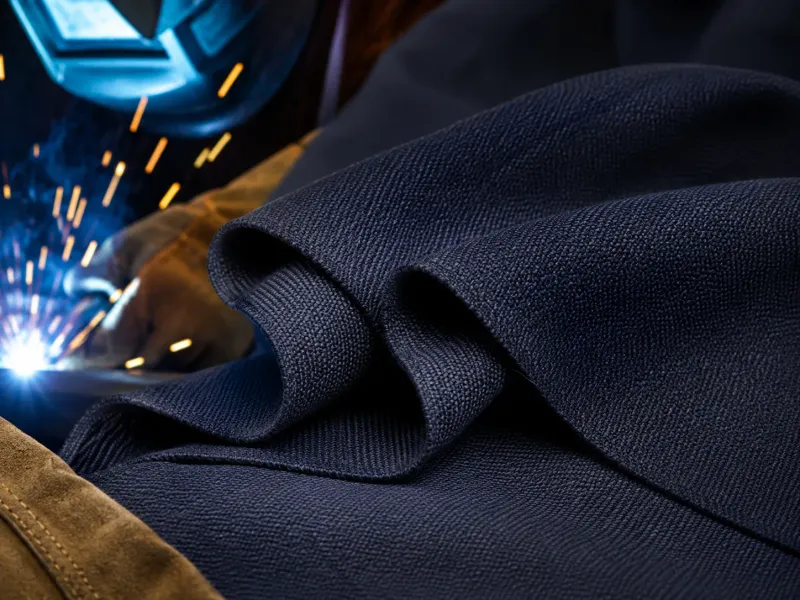
Welding Protective Fabric
Heat and spark resistant fabric designed for welding apparel and industrial protection.
Need Workwear & Protective Clothing Solutions?
Our engineering team can develop custom functional fabric solutions for your specific workwear & protective clothing requirements.
Request a Technical Quote